
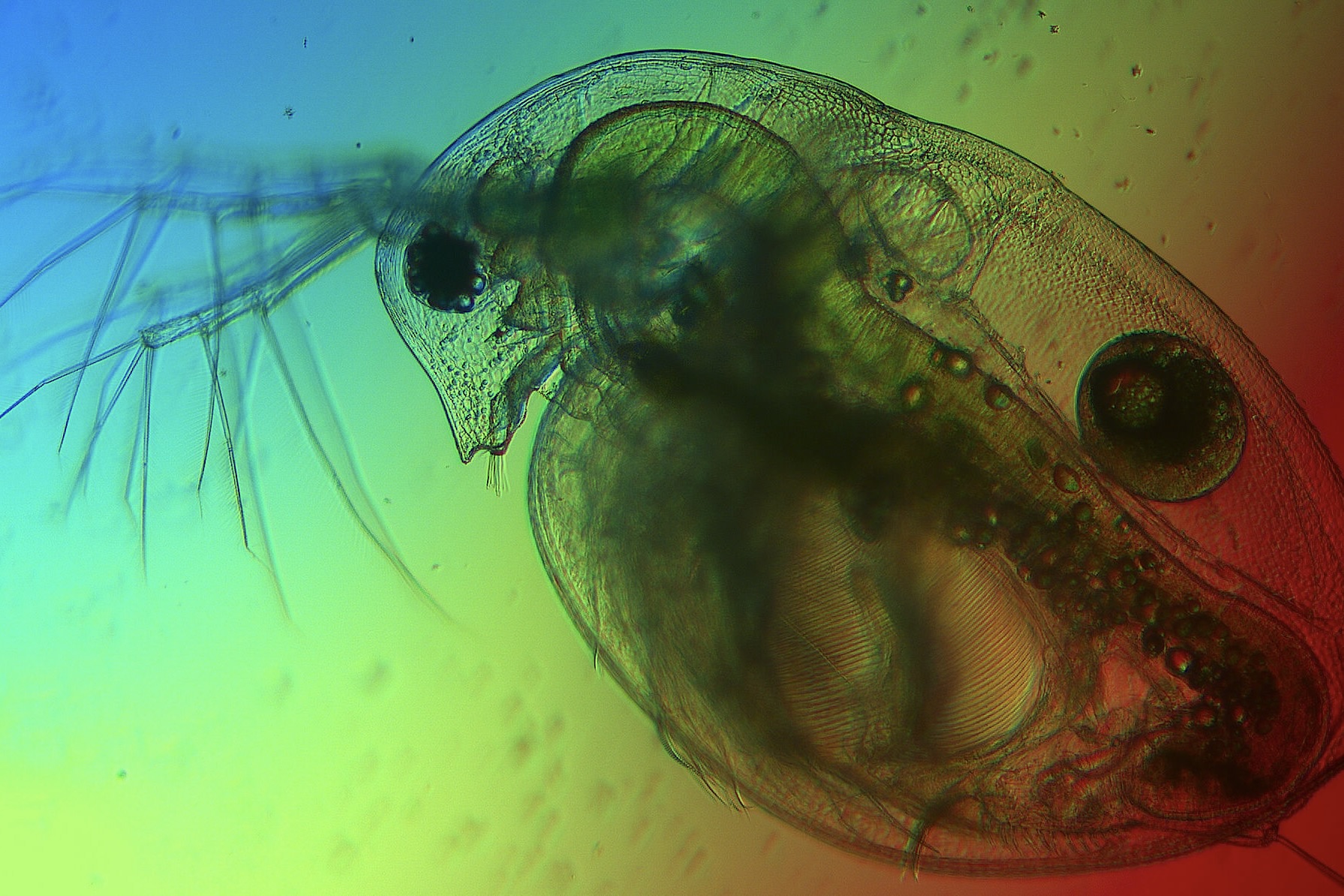
A life in the rainbow: the colour of light determines the growth of algae and water fleas
Phytoplankton is the food source for numerous living organisms. The colour of light is more crucial for microalgae and the lake ecosystem than previously assumed, as a new study by the Universities of Oldenburg and Greifswald shows.
Whether water fleas, copepods or fish: many organisms in bodies of water depend directly or indirectly on phytoplankton via the food web. However, these microscopic algae also play a crucial role in the climate, as they absorb considerable amounts of carbon dioxide (CO₂) in lakes and oceans worldwide, generate oxygen and produce substances that are valuable for the food web, such as omega-3 fatty acids. Phytoplankton obtains the energy it needs for this from sunlight that penetrates the water. A recent joint study by the University of Oldenburg and the University of Greifswald concluded that the colour spectrum of light is also important: from violet to indigo, blue, green, yellow and orange to red – in other words, the seven colours of the rainbow.
Researchers have now discovered that these light colours influence not only phytoplankton, but also the food relationships in the lake. This is shown by a recent study by the University of Oldenburg, conducted in collaboration with the University of Greifswald. It was published in October in the Journal of Ecology.
Sensitive food web in the lake
“Until now, research into ecological processes in bodies of water has focused primarily on the amount of light,” says study author Sebastian Neun from the Planktology Working Group at the University of Oldenburg. “We can now show that the colour of light also has a direct influence on phytoplankton and, subsequently, on food relationships in the lake ecosystem.”
According to the scientists, future research should focus more on the light spectrum. “The amount of microalgae is increasing in many lakes, making them greener and greener,” explains study author and planktologist Dr Maren Striebel. “Light conditions underwater will change even more in the future, affecting the sensitive food web between microalgae and higher organisms.” High nutrient inputs from sewage and agriculture are increasingly promoting algae growth and, especially in combination with higher temperatures, leading to veritable algae blooms in water bodies.
“Until now, research into ecological processes in water bodies has focused primarily on the amount of light,” says Sebastian Neun from the Planktology Working Group at the ICBM at the University of Oldenburg. His colleague, PD Dr Maren Striebel, from the same working group adds: “We have now been able to show that the colour of light also has a direct influence on phytoplankton, zooplankton and material cycles in the lake ecosystem.”
Prof. Dr Alexander Wacker from the Animal Ecology Working Group at the University of Greifswald adds: “In order to better understand the mechanisms behind our findings, we are simulating the changing light and nutrient conditions in lakes in laboratories at the University of Greifswald – using specially developed, computer-controlled experimental setups. In this way, we want to find out how plankton communities react to such conditions and what role the light spectrum in particular plays in the production of fatty acids that are vital for us humans as well.”
A lake becomes a research laboratory
To gather their findings, the research team conducted an experiment in a swimming lake in Lower Saxony in May 2022. The scientists filled bottles wrapped in red, blue and green light filter film with phytoplankton from the lake and placed them at various locations underwater.
Over a period of two weeks, the team observed how the microalgae developed in the bottles under different light conditions and varying amounts of nutrients. The researchers then examined the phytoplankton in the laboratory to draw conclusions about how nutritious it is for water fleas as a result of the different light and nutrient influences.
The result: the fewer light rays that reached the microalgae underwater, the more crucial the colour spectrum became for their growth. Different phytoplankton species also reacted differently to the colours of light. Both the nutrient content and the composition of fatty acids changed. This in turn influenced the growth of water fleas, which feed on microalgae. “This suggests that light colours also influence the food web in the lake,” says Neun. “So we can see that the colour spectrum of light underwater has a much greater influence than previously assumed.”
The team is already investigating the special role of light colour for phytoplankton in a three-year research project.
Weitere Informationen
Abteilung Tierökologie am Zoologischen Institut und Museum der Universität Greifswald
Link zur Veröffentlichung
Ansprechpartner an der Universität Greifswald
Prof. Dr. Alexander Wacker
Zoologisches Institut und Museum
Abteilung Tierökologie
Loitzer Straße 26, 17489 Greifswald
Telefon +49 3834 420 4266
alexander.wacker@uni-greifswald.de
Ansprechpartner an der Universität Oldenburg
Sebastian Neun
Institut für die Biologie und Chemie des Meeres
AG Planktologie
sebastian.neun@uni-oldenburg.de
www.uni-greifswald.de/aktuell
www.uni-greifswald.de/veranstaltungen

